

Nations or Nihilism
A Platonic-Christian Defence of Nationalism

Nations and borders—these most basic facts of politics—are also, in some ways, the most controversial. The Western tradition sacralized the border, made holy the dividing line. But the political aesthetics of nationhood, the admiration for collective identities grounded in their own traditions as the building blocks of world order, is largely lost to mainstream discourse today.
Plato and the Prophets
We can start with Plato’s account of the origin of nations in Critias:
“At one time, the gods received their due portions over the entire earth, region by region—and without strife … as they received what was naturally theirs in the allotment of justice, they began to settle their lands … they did not compel us by exerting bodily force on our bodies … but rather … they directed us from the stern, as if they were applying to the soul the rudder of Persuasion … as the gods received their various regions lot by lot, they began to improve their possessions.”
—Plato, Critias, 109b
In The Laws, he specifies that it was Cronos who appointed gods to rule over different human realms.
So Cronus … who was well-disposed to man … placed us in the care of the spirits, a superior order of beings, who were to look after our interests … the result of their attentions was peace, respect for others, good laws, justice in full measure, and a state of happiness and harmony among the races of the world.
—Plato, The Laws, 713a
Plato’s account in the Critias and the Laws contains essentially the same idea as the Bible, Deuteronomy (32:8-9):
“When the Most High divided to the nations their inheritance, When he separated the sons of Adam, He set the bounds of the people according to the number of the children of El. For the Lord’s portion is his people; Jacob is the lot of his inheritance.”1
These “sons of God” or angels are Plato’s gods, and Plato’s Kronos is the Bible’s El (also recall that Plato rejects the myth according to which Kronos castrated his father and was in turn overthrown by his son in The Republic.)
Importantly, Plato’s language of gods receiving their allotment peacefully—not as a matter of conflict, but as flowing from divine creativity—closely parallels what we find in the Book of Jubilees about the great-grandsons of Noah receiving their regions of the earth by lot and then going off to populate them. The nations mentioned in Jubilees partly correspond to existing nations in antiquity and even the modern era. Since the events of Genesis 10 precede the Tower of Babel, it would seem that the later “confusion of tongues” at Babel was, in part, a return to the previous order. National diversity isn’t a punishment, it’s the proper order of things, which is reiterated as gift in the Acts of the Apostles when the Spirit descends as tongues of fire and blesses the many languages of the disciples.
In the Greek world, the idea that division is divinely ordained precedes Plato and is fundamental to the Hellenic understanding. Herodotus’s Histories, for example, can be read as “drawing systematic attention to proper realms,” as Donald Lateiner puts it in The Historical Method of Herodotus. As an example, we have the curious anecdote of the oracle of the god Ammon in Egypt determining the proper limits of Egyptian nationhood based on geography—where geography is providential:
“The men of the cities of Marea and Apis, in the part of Egypt bordering Libya, believing themselves to be Libyans and not Egyptians, and disliking the injunction of the religious law that forbade them to eat cow’s meat, sent to Ammon, saying that they had no part of or lot with Egypt—for they lived, they said, outside the Delta, and did not consent to the ways of its people—and they wished to be allowed to eat all foods. But the god forbade them: all the land, he said, watered by the Nile in its course was Egypt. Such was the oracle given to them.”
—Herodotus, Histories, II:18
This is sacred political geography.
We don’t generally have this idea of theo-geographers determining the spiritual limits of nations anymore, but it wasn’t a strange way to think about things for the ancients.
The love of lines, of distinct characteristics, of strong borders and strong personalities—the ethos according to which tall fences make good neighbors—is largely anathema to a lot of modern politics.
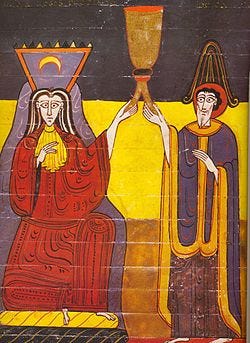
Two Biblical symbols illustrate this: the Tower of Babel, maiming and mutilating all difference into one uniform whole (the masculine perversion toward uniformity), and at the end of the Bible, in the Apocalypse, the cup of Babylon—not mutilating, but melting all difference into one undifferentiated mass (the feminine perversion toward uniformity). A proper balance allows for distinction: wholeness within harmony, coherence within community (masculine and feminine, yang and yin, Proclus’ Limit and Expansion).
But the symbols of Babel and Babylon, of tower and cup, show us how, when the energies of the male and the female, respectively, are perverted, we get the destruction of specificity, the breakdown of selves.
Dionysian Christianity
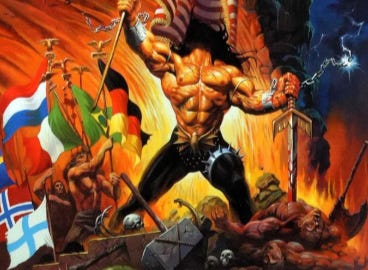
Some Christian theologians proposed that the angelic fall from Heaven implies a process whereby national, tutelary angels accepted worship from their wards, becoming corrupt and leading the nations under their care into apostasy. This would have been rectified by conversion to Christianity.
In contrast, the view of St. (Pseudo-2) Dionysus the Areopagite recognizes that the “higher-order realities” or archetypes that those angels correspond to are not themselves corruptible. Through him, we may read the Bible as implying that people went astray by worshiping other than God, whereupon unclean spirits interposed themselves between them and their rightful angelic guides, or lower intelligences became corrupted. The traditional Christian notion that pagan gods are demons is thus retained without imputing sin upon the higher angelic stewards.
The opposite view was taken quite far by Origen of Alexandria, who maintained that the emergence of distinct nations was a fall in the first place, after which angelic guidance was made necessary. Origen suggests that Israel never had any need of such guidance because it remained under the direct instruction of God, without a mediating angel. Ultimately, however, everything is under the direct instruction of God, so that all mediation is a display of His creative power and not an object between Him and us (as though God were a discrete cause in a series of temporal causes and effects).
Therefore does St. Dionysus (like St. Maximus the Confessor) argue that God chose Israel for an age simply because Israel remained tethered to proper monotheism through its prophets, but it is not structurally distinct from other nations, having a specific angel like the others do. All nations, in other words, are equidistant from God, Israel alike the rest:
“The Word of God has assigned our Hierarchy to Angels, by naming Michael as Ruler of the Jewish people, and others over other nations. For the Most High established borders of nations according to the number of Angels of God. But if any one should say, ‘How then were the people of the Hebrews alone conducted to the supremely Divine illuminations?’ we must answer, that we ought not to throw the blame of the other nations wandering after those which are no gods upon the direct guidance of the Angels, but that they themselves [the nations], by their own declension, fell away from the direct leading towards the Divine Being.”
—St. Dionysus, The Celestial Hierarchy, IX:2-3
From the pagan perspective, Proclus (with whom St. Dionysus is in philosophical agreement) clarifies this in The Elements of Theology where he explains that every effect is contained in its immediate cause but also, more perfectly, in preceding causes, so that everything is ultimately contained in The One (he’s speaking of vertical, existential causation here)3.
It is in these terms that traditional language concerning God as the only true agent, and intermediation as unnecessary, should be approached. When tradition speaks of God acting ‘directly,’ it reminds us that He can always choose to produce a sui generis cause, and an agent conscious of God’s will can be described as God’s act.
But Origen’s view reifies this idea. It is, ultimately world-denying (ironically given Origen’s refutations of dualistic, “gnostic” heresy). Jean Danielou (whose opinion on Origen I’m going off of) explains:
“The political order dependent on the existence of a variety of nations … was henceforth over and done with … [Origen] regarded polyarchy as a system going with polytheism … Monarchy [one state over all humanity] was to appear at the end of the world.”
—Jean Danielou, Origen
For Origen, the “monotony of monarchy,” where monarchy here means rulership of one, as in world-government, includes cultural homogenization. He seems to consider the contingent features associated with the nation of Israel, including the Hebrew language, as constituting the ideal character of humanity that all will adopt.
Jesus precisely rejects this centralizing uniformity when he describes his coming absence from the disciples as a good thing, as though their focus on his physical presence might impede their spiritual development:
“But very truly I tell you, it is for your good that I am going away. Unless I go away, the Advocate will not come to you; but if I go, I will send him to you.” (John 16:7)
and,
“Woman, believe Me, the hour cometh when ye shall neither on this mountain, nor yet at Jerusalem, worship the Father…the true worshipers shall worship the Father in spirit and in truth; for the Father seeketh such to worship Him.” (John 4:20-23)
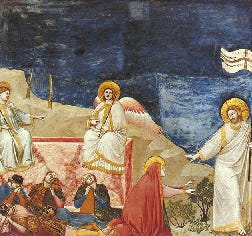
John’s Apocalypse (21:22) likewise has the diversity of nations healed, fed and taken into a Heavenly City with no physical centre:
“I saw no temple in it, for the Lord God Almighty and the Lamb are its temple.”
I call this vision the “Fractal Empire” with its absent or “Asymptotic” Centre, partly realized in the Middle Ages.
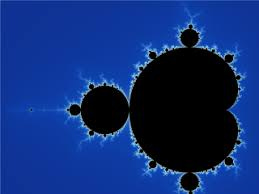
So, when certain critics of Christianity describe it as “globalist” or “proto-communist” they are right that such a current was there from early on, there was always the contrast between the view of Origen and St. Dionysus, the woke and the based, but the latter represents its true character.
Concerning the flawed metaphysics in Origen and the contrasting medieval conception, Arthur Lovejoy writes:
“Origen had, in connection with his doctrine of the pre-existence of souls, declared that God’s goodness had been shown at the first creation by making all creatures alike spiritual and rational, and that the existing inequalities among them were results of their differing use of their freedom of choice. This opinion Aquinas declares to be manifestly false. [Writes Aquinas:] “The best thing in creation is the perfection of the universe, which consists in the orderly variety of things … Thus the diversity of creatures does not arise from diversity of merits, but was primarily intended by the Prime Agent.” The proof offered for this is the more striking because of the contrast between its highly scholastic method and the revolutionary implications which were latent in it.”
—Arthur Lovejoy, The Great Chain of Being
Lovejoy calls this the “principle of plenitude,” a key concept for distinguishing true Tradition (capital ‘T’) from mere reactionary traditionalism.
God’s unity cannot be identified with a created uniformity, for no created form can express that unity better than some other conceivable equivalent form. Equally perfect equivalent forms are always possible; a panther is as much a feline as a tiger; circularity will only ever appear in specific circles, whose substance (crayon on a page, light on a screen, etc.) is always accidental vis the definition of a circle itself.
Nicholas of Cusa encapsulates the point in De Pace Fidei’s aphoristic
“Equality is the unfolding of form in oneness.”
—Nicholas of Cusa, De Pace Fidei
Diversity reminds us that God is transcendent, for no particular form can express Him, and that God is present, for all particular forms express Him. Plurality (of causes in time, and of nations in space) expresses God’s unity4.
Thus do we find that the world consists of “joints,” as Plato taught; borders between forms and categories of forms. If all circles were continuous with each other, none of them would be a circle, their outlines must be discontinuous for them to all manifest that common shape.
They must each be themselves in order to all be alike.
The One and the ones
To bind a thing up is to express its universal character. We can think of ‘beauty’. I cannot make a painting beautiful unless I perfect its specific beauty, rather than imitating the beauty of myriad things. A race horse, a sunset, a woman, are all beautiful, but they are also quite distinct. Apart from more practical considerations, therefore, projects such as the development of a culture and identity have need of borders for the same reason.
Arthur Lovejoy summarizes the point:
“A universe that is full, in the sense of exhibiting the maximal diversity of kinds, must be chiefly full of ‘leaps.’ There is at every point an abrupt passage to something different.”
If many circles were continuous with one another, they wouldn’t have the outline of a circle and so would cease to be circles.
They must be discontinuous from one another to share the same shape with one another.
No differentiation can occur as pure accident: Both genus and differentia manifest archetypes. Blue is no less an “idea” than circle. A pyramid does not cause us to contemplate God only by implying a perfect, singular point at its peak, but also by implying the potentially infinite extension of its base. Everything is an expression of Divine Unity: Whether you move upward to contemplate general categories that encompass many things or downward towards ever-more niche instances of some category, both are the encompassing category or the new specificity are cases of becoming “one. They are manifestations of “The One.” (Talk of “the one and the many” is more properly of “One and ones” or “One and Its names.”)
The idea that equivalent forms are always possible (for no one form can exhaust God’s Self-disclosure) and that any authentic differentiating feature expresses something from God (for nothing exists apart from His Being) are expressed by Nicholas of Cusa in On Learned Ignorance:
“All the names are unfolding of the enfolding of the One, Ineffable Name, and as this proper name is infinite, so it enfolds an infinite number of such names of particular perfections. Although there could be many such unfoldings, they are never so many or so great that there could not be more; each of them is to the proper and ineffable name what the finite is to the infinite.”
—Nicholas of Cusa, On Learned Ignorance
Nicholas precisely applies this principle to national diversity. As Michael Harrington observes in Sacred Place in Early Medieval Neoplatonism:
“Nicholas had long thought of the division of human beings into distinct regions and nations as an important stimulus to world harmony … following both Eckhart and the humanists [we would add St. Dionysus] he was able to assess the diversity of human languages non-instrumentally and positively as the different ‘points of view’ of an ‘explicating’ and always partial human reason.”5
—Michael Harrington, Sacred Place in Early Medieval Neoplatonism
We can apply this idea to cultural differences in general: There is no single cultural expression (linguistic or otherwise) that most perfectly captures the human condition and God’s design, over and against all possible alternatives.
We may now contrast this tradition against the view that the existence of nations is, at worst, a tragic necessity, a bulwark against worse things, or at best, an accidental feature of life.
Because the modern mind does not believe in archetypal disclosure (‘names’ of God) it understands diversity as resulting from random, chaotic processes. Unfortunately, this view occurs in ‘traditional’ conservative thought as well. This is the case among Catholic thinkers, for example, to the degree that they have, sometimes unconsciously, accepted the idea that nature receives grace in an act which is extraneous to its character, being inherently devoid of grace, and that God could have chosen to create a world in which nature was never oriented towards salvation through grace. Such a view is sometimes described as “two-tier Thomism,” the bottom tier being natura pura, pure nature, and the top being grace.
Imperial Fractal Federalism
Politically, we may seek guidance from Plato’s vision of Hellenic federation, a virtuous equivalent to the yoke of that Persian conquest whose tyranny the Athenian precisely criticizes in The Laws for its effacement of the distinction of peoples, but whose imperial imperative can be imitated in an organic form.
There is virtue, in any case, in the aesthetic love for strong borders, strong nations. This doesn’t mean perfectly siphoned-off, hermetically sealed units—there is always porosity—but reality consists of definite characters that have the right to preserve themselves and unfold their potentialities over time.
That’s the key.
The term “sons of El” sometimes appears as “sons of Israel, but I’m using the version found at Qumran in Palestine—in any case, Israel as microcosm for humanity, the number of nations would be the same. The more theologically correct term, “angels of God,” appears in the Greek Septuagint.
Or Deutero-Dionysus, more piously.
The neo-Platonic view of God isn’t of an impersonal, static, sterile unity, as is sometimes imagined.
We also find this concept in the Qur’an in the context of national diversity being the proper means for humans to recognize/distinguish between each other. 49:13: “O mankind, We have created you from male and female and made you peoples and tribes that you may recognize one another,” and 30:22: “And one of His signs is the creation of the heavens and the earth, and the diversity of your languages and colours. Surely in this are signs for those of sound knowledge.”
Therefore, Harrington notes, Nicholas had “no interest in a mystical ursprache [a single original human speech] nor in a ‘natural’ and universal language.”
One of the best and the clearest articles on this subject I've read on substack. Thank you.
Thank you for this! I would like to see more of this kind of stuff on Substack. I look forward to checking out more of your work.